
The Dashboard That Changed Everything: Real Story of BI in Marketing
BI
Advertising
Analytics

The Challenge
In this case study, we examine the impact of Business Intelligence (BI) on the video content strategy of a news portal organic reach on multiple social media platforms such as Instagram, TikTok, Facebook, and YouTube. The portal regularly produces video content to engage its audience, but managing campaign performance across these platforms can be challenging due to fragmented data and manual reporting processes.
The primary challenge was gathering data manually from different platforms, which led to inconsistencies in reporting and delayed decision-making. Each platform provided its own set of performance metrics—such as video views, likes, comments, and shares—but there was no unified system to compare how each video performed across different platforms. This lack of centralized insights hindered the ability to fully understand the audience’s behavior and adjust the content strategy accordingly.
Our Approach
The implementation of BI tools like Supermetrics and Looker Studio helped automate data collection and visualize campaign performance across platforms. Supermetrics was used to pull key performance indicators (KPIs) such as reach, video views, interactions (likes, shares, comments), and engagement rates from Instagram, TikTok, Facebook, and YouTube. This data was then integrated into a single dashboard using Looker Studio, allowing the marketing team to compare video performance across platforms in real-time.
This report serves as a baseline for tailoring a future advertising strategy on social media platforms. The results provided in this analysis are based purely on organic reach and engagement without the influence of paid advertising. By examining the organic performance across Instagram, TikTok, Facebook, and YouTube, we can determine how to allocate advertising resources more effectively and strategize for an optimized campaign.
Overview of video performance across multiple social media platforms (Instagram, TikTok, Facebook, and YouTube) for the last week.
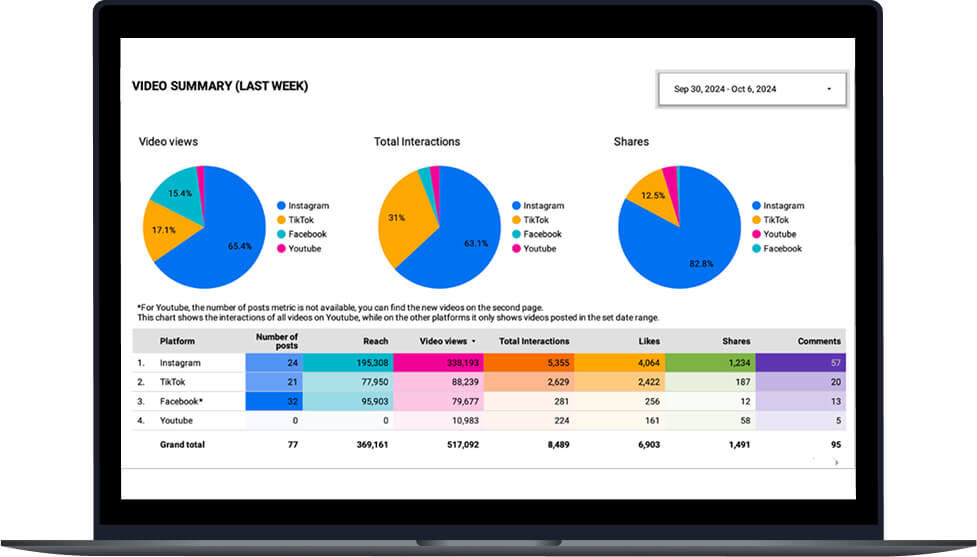
Instagram appears to be the most powerful platform for driving video engagement, while TikTok shows strong interaction despite lower reach. Facebook struggled with engagement despite its reach, and YouTube provides some value but is limited in available data.
Our Advice
Focus more on Instagram, as it is the top-performing platform in terms of reach, video views, and overall engagement. Allocating more resources to Instagram and continuing to invest in video content and ads will likely maximize audience interaction.
For TikTok, while it has lower reach than Instagram, its strong engagement indicates that the content resonates well with the audience. Increasing the frequency of content or experimenting with different creative formats could further boost its performance.
On the other hand, Facebook shows decent reach but low engagement, suggesting a need to reevaluate the content strategy, potentially by revising the ad creatives or adjusting audience targeting to improve interaction.
YouTube, though limited in available data, shows potential with shares and likes, so it may be worthwhile to post more consistently and explore its strengths for long-form content. Additionally, experimenting with different content types across platforms, such as short-form videos for TikTok and Instagram Reels and longer videos for YouTube, can help optimize performance.
Cross-platform promotion could also be beneficial, leveraging Instagram’s strong engagement to promote content on TikTok and YouTube for increased visibility. Lastly, improving call-to-actions (CTAs) on platforms with lower engagement, like Facebook and YouTube, could encourage more user interaction, such as likes, shares, and comments.